
Google Maps for carpet cleaners: how local visibility actually works.
For a carpet cleaner, appearing prominently in Google Maps can put the business directly in front of nearby customers who are ready to compare providers. But Maps visibility is not created by one trick, one setting or endlessly posting to a Google Business Profile.
Why Google Maps matters so much to carpet cleaners.
Carpet cleaning is a local service. When somebody searches for a carpet cleaner, Google can show local businesses prominently within Search and Maps before the customer explores the wider organic results.
That makes a well-managed Google Business Profile an important part of a carpet cleaner’s search presence. Customers can see information such as the business name, reviews, photographs, services, opening hours, phone number and website without needing to discover the company through a traditional website result first.
But the profile should not be treated as an isolated marketing channel. Google says it can compile Business Profile information from several sources, including information supplied by the business, user contributions and publicly available web content such as the company’s own website.
That is why our approach to SEO for carpet cleaners connects Maps visibility with the website, service relevance, location targeting, reviews and genuine evidence about the business.
Relevance, distance and prominence.
Google publicly describes these as the three main concepts used to determine local results. They are useful because they explain both what a carpet cleaner can improve and what remains outside its direct control.
Does the business match the search?
Google describes relevance as how well a Business Profile matches what somebody is searching for.
For a carpet cleaner, this makes accurate categories, services and detailed business information important. The website should also clearly explain the services the business genuinely provides.
How far is the business from the searcher?
Google considers how far each potential result is from the person searching. If the searcher does not specify a location, Google can estimate their location from the information available to it.
This is one reason a carpet cleaner cannot expect identical Maps rankings across every town in a large service area.
How established does the business appear?
Google describes prominence as how well known a business is and says that factors can include information Google has about the business from across the web, links and reviews.
More reviews and positive ratings can help local ranking, while strong wider web visibility can reinforce the business beyond the profile itself.
Get the fundamentals right before chasing tactics.
Google advises businesses to keep their information complete and accurate. For a carpet cleaning company, the basics should therefore be correct before worrying about clever posting schedules or other supposed ranking tricks.
- Use the real business name. Do not add town names or extra keywords to the profile name unless they genuinely form part of the business’s real-world name.
- Choose an appropriate primary category. Google says categories help connect businesses with customers searching for their services and recommends choosing the most specific category that describes the business.
- Complete the service information. Make it clear which genuine services are available, such as carpet cleaning, upholstery cleaning or other relevant work.
- Keep hours and contact details accurate. Customers should be able to understand when the business operates and how to contact it.
- Use genuine photographs. Real images of the business, equipment and completed work can help customers understand what they are choosing.
- Keep the website consistent. The website linked from the profile should clearly support the services and business identity represented on Google.
Businesses that want this handled for them can also see our Google Business Profile management service.
Carpet cleaners need to understand the service-area rules.
Many independent carpet cleaners travel to customers rather than receiving customers at their own premises. Google classifies this type of operation as a service-area business.
If customers are not served at the business address, Google’s guidance says the address should not be displayed publicly on the Business Profile. The business can instead specify the areas it serves.
Google currently allows up to 20 service areas and recommends using specific cities, postcodes or other areas rather than a radius. It also says the overall service area generally should not extend more than around two hours’ driving time from the business base, although larger areas can be appropriate for some businesses.
If expanding into surrounding towns is commercially important, the website may also need stronger location relevance. Our guide to carpet cleaning location pages explains how to approach that without creating dozens of thin copied pages.
Reviews matter — but don’t turn them into a numbers game.
Reviews can influence both how the business appears to potential customers and its local-search presence. Google explicitly says that more reviews and positive ratings can help local ranking.
Ask real customers.
Build a simple process for inviting genuine customers to leave feedback after completed work rather than trying to manufacture review volume.
Engage with reviews.
Google recommends responding to reviews. Thoughtful replies also show prospective customers that the business pays attention to its reputation.
Think long term.
A sustained body of genuine customer feedback is more useful than obsessing over an arbitrary target such as reaching a particular number of reviews as quickly as possible.
Show customers the business they are considering.
Google encourages businesses to add photos and videos to their profiles. For carpet cleaners, this is particularly useful because the work is naturally visual.
Genuine photographs can help a potential customer see that there is a real working business behind the listing.
Useful carpet-cleaning imagery might include:
- Technicians carrying out genuine cleaning work.
- Professional machinery and equipment.
- Before-and-after examples where appropriate.
- Carpet and upholstery cleaning in real properties.
- Branded vehicles and genuine business assets.
- Specialist work the business actually wants more of.
Your Google profile and website should support each other.
Google says Business Profile information can be compiled from publicly available web content as well as information supplied directly by the business and its customers.
That is one reason we do not treat Maps optimisation as completely separate from website SEO.
If the profile says a company provides carpet cleaning, upholstery cleaning and commercial work across a particular operating area, the website should make those genuine services and locations easy to understand too.
This is where carpet cleaning keyword research becomes useful. It helps identify which services and customer searches deserve proper coverage rather than simply repeating keywords inside the Business Profile.
The website can then provide the depth that a Business Profile cannot: detailed service information, genuine project evidence, FAQs, location relevance, case studies and stronger reasons to choose the company.
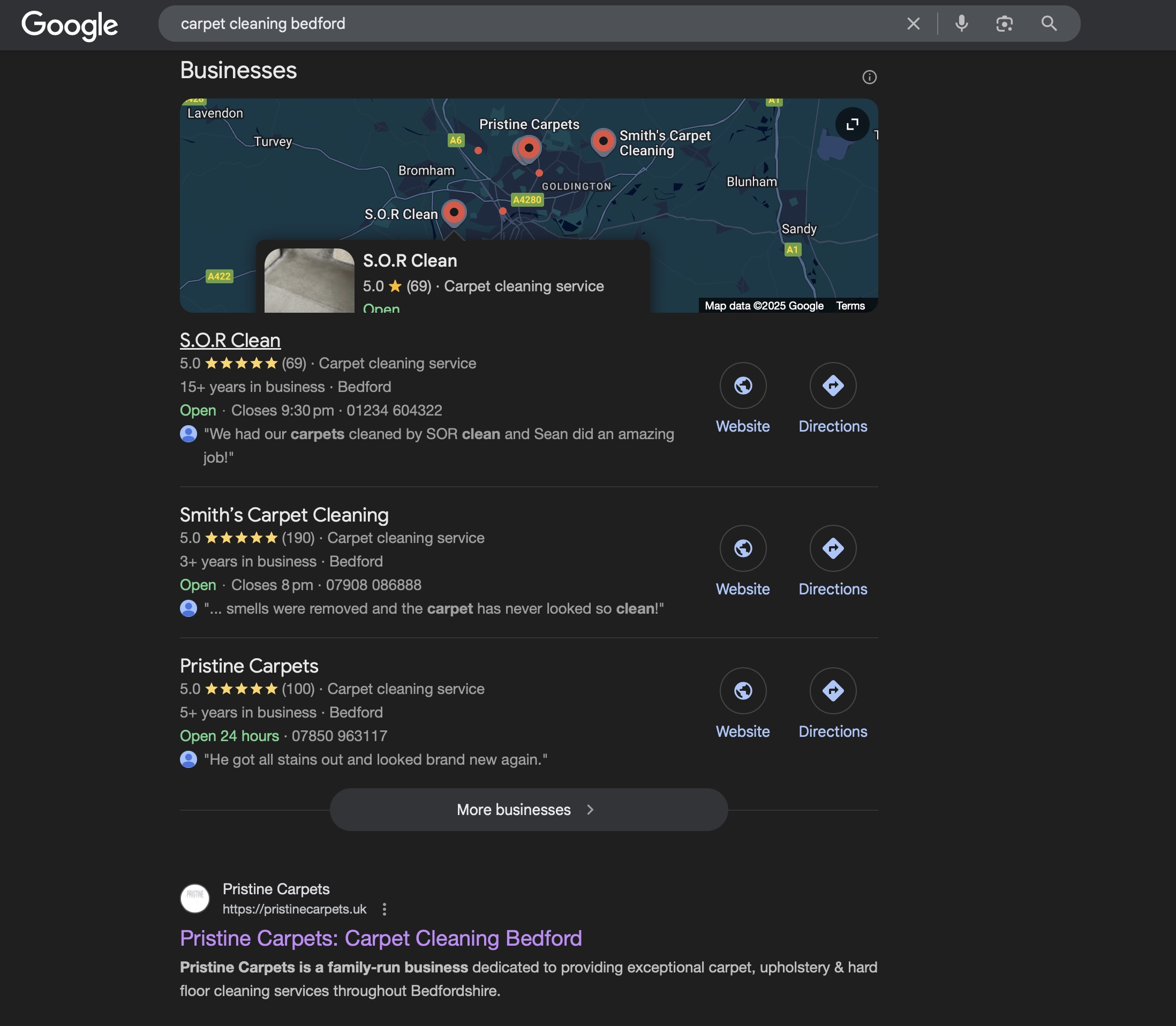
Pristine Carpets: Maps and organic visibility working together.
Our work with Pristine Carpets is a useful example of why local SEO should not be divided into disconnected pieces.
The strategy has included Google Business Profile work, website improvements, service relevance, location coverage and reputation rather than relying on a single supposed Maps-ranking trick.
The recorded case-study snapshot includes strong Google Maps visibility alongside #1 organic visibility for Carpet Cleaning Bedford.
You can see the wider work in the Pristine Carpets SEO case study.
Rankings shown are recorded case-study snapshots. Search results vary by location, device and time, and no ranking position is guaranteed.
What carpet cleaners should stop obsessing over.
Local SEO becomes unnecessarily complicated when businesses concentrate on activity for activity’s sake instead of the fundamentals Google and customers can actually use.
Keyword stuffing the business name
Adding phrases such as “Carpet Cleaning Cardiff” to a profile name is not appropriate unless that is genuinely part of the real-world business name. Google’s guidelines require the profile name to reflect how the business is consistently represented offline.
Creating fake locations
Virtual offices and addresses where the business does not genuinely operate are not a legitimate shortcut to wider Maps coverage. Google has specific eligibility rules for service-area businesses and physical locations.
Adding every town imaginable
Service areas should accurately describe where the business operates. Adding a town to the profile does not override Google’s distance consideration or guarantee visibility there.
Posting just to hit a schedule
Keeping a profile useful is sensible, but there is no need to treat an arbitrary posting frequency as the central Maps-ranking strategy.
Buying irrelevant links or citations
More mentions are not automatically better. Build a credible real-world business presence rather than accumulating low-quality listings purely to increase a spreadsheet count.
Checking one ranking from one location
Maps results can change with the searcher’s location. One manual search does not show how the business appears across an entire service area.
For the wider explanation, see our guide to the three things Google says local rankings are mainly based on.
What should a carpet cleaner work on first?
Rather than constantly looking for the next Maps trick, build the fundamentals in a sensible order.
Maps or organic search? Build for both.
A customer searching for a carpet cleaner can encounter the business through local Maps results, through the website in the organic results, or through both during the same decision.
That is why we would not build a carpet cleaner’s strategy around Maps alone.
The Business Profile gives Google and customers concise information about the company. The website gives the business room to demonstrate expertise, explain services, target worthwhile locations and provide much stronger evidence.
For a broader explanation of the distinction, read Google Maps vs organic search.
Or see our complete SEO for carpet cleaners service for how we combine the different parts.
Google Maps for carpet cleaners: FAQs.
How does a carpet cleaner rank higher on Google Maps?
There is no single setting that guarantees higher Maps rankings. Google says local results are mainly based on relevance, distance and prominence. Carpet cleaners should therefore concentrate on accurate and complete business information, appropriate categories and services, genuine reviews, useful photos, a strong website and a credible wider business presence.
Does adding more service areas improve Google Maps rankings?
Adding service areas tells customers where the business operates, but it does not guarantee higher rankings in those places. Distance remains one of Google’s main local-ranking considerations.
Should a carpet cleaner show a home address on Google?
If customers are not served at that address, Google’s guidance says a service-area business should remove the address from the public profile and specify its service area instead.
Do Google reviews help carpet cleaners rank?
Google states that review count and positive ratings can contribute to local ranking. Reviews also provide visible evidence to customers comparing local businesses, so building a steady flow of genuine customer feedback can support both visibility and trust.
How often should a carpet cleaner post on Google Business Profile?
There is no universal posting frequency that guarantees better Maps rankings. Keep the profile accurate and useful, and publish relevant updates when there is something worthwhile to communicate rather than treating an arbitrary schedule as the core ranking strategy.
Does a carpet cleaner still need a website if it has a Google Business Profile?
A strong website remains valuable. It can explain services and locations in much greater depth, provide case studies and evidence, target organic searches and give customers another route to discover and evaluate the business. Google also says publicly available web content can be one source of information used in Business Profiles and local search.
Want stronger Maps and organic visibility for your carpet cleaning business?
We connect Google Business Profile management, website SEO, location relevance, reviews and genuine business evidence into one local-search strategy.