
Google Maps vs organic search for trades: where do customers actually find you?
When someone searches for a roofer, electrician, cleaner, plumber or another local trade, Google may show map results, normal organic listings and other search features on the same results page. That means local businesses should understand how Google Maps and organic search work together rather than treating them as competing strategies.
Short answer: customers can discover a trades business through both Google Maps and normal organic results. Which section is most prominent depends on the search itself and the results Google chooses to show. For most local trade businesses, the stronger strategy is therefore to build visibility across both rather than relying on only one.
A local Google search isn’t one set of results.
Search for a local trade and you may encounter several different types of result on the same search results page.
Google can show paid results, a local map section, normal organic webpages and other search features depending on the query.
This matters because appearing in the map results and appearing organically are related local-search opportunities, but they are not the same thing.
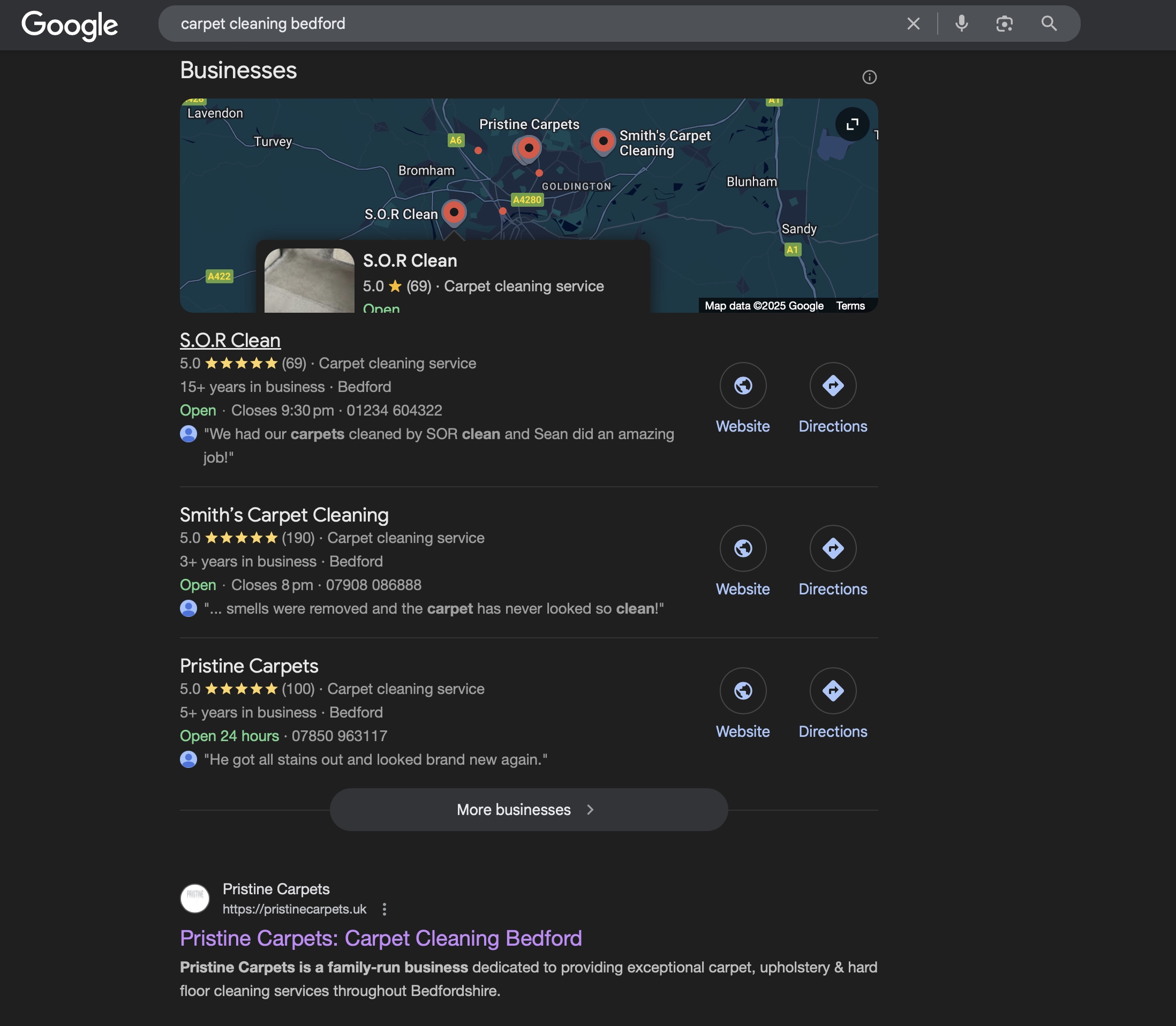
A real search example from our work with Pristine Carpets. The search for “carpet cleaning Bedford” shows the local business results first, with the Pristine Carpets website also appearing organically below. It is a useful example of why Maps and organic visibility should be treated as two parts of the wider search presence rather than an either/or decision.
They give a trade business different ways to be discovered.
Strong local discovery.
Map results are closely connected to the business’s Google Business Profile and its relevance to a local search.
- Business information
- Reviews and ratings
- Photographs
- Calls and directions
- Local geographic relevance
Broader website visibility.
Organic results allow individual website pages to target specific services, locations and customer questions.
- Core service searches
- Location-led searches
- Specific customer problems
- Commercial research
- Informational searches
Why Maps can be so valuable for trades.
Many trade searches have an obvious local requirement. Someone with a leaking roof, dirty carpet or electrical problem usually needs a business that can actually serve their area.
Google’s local results can make it easy to compare nearby businesses without first navigating through several websites.
The searcher may be able to see important information such as the business name, reviews, photographs, opening information and contact options directly from the local result.
For this reason, a properly maintained Google Business Profile is an important part of local visibility for many trade businesses.
Your website can target far more than one local listing.
A Google Business Profile represents the business. A website can contain a whole architecture of pages built around the different things potential customers search for.
Individual services
Important services can have dedicated pages that explain the work, answer questions, demonstrate experience and provide a clear route to enquire.
Priority locations
Selected towns and cities can have useful local pages where there is a genuine market and sufficient reason for the page to exist.
Specific problems
Customers do not always search for the formal name of a service. Useful pages can answer the problems and questions that lead to a commercial enquiry.
Research before contact
Guides, FAQs, projects and supporting content can reach customers while they are comparing options or deciding what work they need.
Not every trade search produces the same opportunity.
Consider the difference between somebody searching for “roofer near me” and somebody searching “how much does a new roof cost?”
The first has a very strong immediate local intent. The second is researching a service and may encounter useful organic content before choosing a contractor.
Even closely related searches can produce different layouts and different types of result.
This is why there is no useful universal answer such as “Maps is more important than organic” or “organic is more important than Maps”.
The commercially useful question is: which searches matter to your business, and where can you realistically earn visibility for them?
A customer can move between Maps and your website.
The place where somebody first discovers a business is not necessarily the place where they make the decision to contact it.
Customer searches
They search for a trade, service, problem or local provider.
Business appears
They encounter the company through Maps, organic search or another Google result.
They look for proof
Reviews, photographs, services, projects and website content help them decide whether the business looks suitable.
They enquire
The final action may be a call, form, WhatsApp message or another contact route.
Ranking in Maps doesn’t make the website irrelevant.
A strong local listing can generate direct actions, but customers may still visit the website before making contact—particularly for higher-value or less urgent work.
The website gives the business room to explain services in detail, show completed work, establish expertise and answer questions that cannot sensibly fit inside a business listing.
It also creates additional opportunities to appear organically for searches beyond the immediate map result.
If the website itself is the weak point, our trades website checklist covers the core elements worth having in place.
A location page does not create a Google Maps location.
This is one of the most important distinctions for a service-area trade business.
A useful page about serving a particular town may have an opportunity to appear in the normal organic results for relevant searches.
But adding that page does not mean the business suddenly has a physical presence in the town or will automatically appear prominently in its map results.
That is why location-page expansion should be planned around organic search opportunity and genuine service coverage—not used as a way of pretending the business has premises everywhere it works.
Planning location pages?
Start with Service Pages vs Location Pages for Trades and then use our guide to how many location pages a trade business needs to decide which markets actually warrant dedicated pages.
Google Maps vs organic search for trades.
| Area | Google Maps / local results | Organic website results |
|---|---|---|
| Main asset | Google Business Profile | Your website and individual webpages |
| Geographic role | Strongly connected to local relevance and business location/service area signals | Pages can target relevant services and selected geographic markets |
| Reviews | Highly visible directly within the business profile | Can be incorporated into pages as customer proof |
| Service depth | Limited compared with a full website | Dedicated pages can explain individual services in detail |
| Content range | Focused around the business profile | Services, locations, projects, FAQs, guides and more |
| Customer action | Can support direct calls, directions and profile interactions | Can support calls, forms, WhatsApp and detailed enquiry journeys |
| Best approach | Treat both as parts of the same local search strategy rather than assuming one replaces the other. | |
What if both your Maps and organic visibility are weak?
Start by getting the fundamentals of both assets right rather than chasing isolated ranking tricks.
- Make sure the Google Business Profile accurately represents the real business.
- Ensure the website clearly explains the core services.
- Build genuine customer proof through reviews and completed work.
- Make contact details and enquiry routes clear and consistent.
- Develop useful pages for commercially important services.
- Add selected location pages where genuine opportunity justifies them.
- Connect relevant pages with sensible internal links.
- Measure which searches and landing pages are actually producing visibility and enquiries.
Continue with the local SEO strategy.
Local SEO for Trades: The Complete UK Guide
See how the website, Google Business Profile, services, locations, proof and supporting content fit together.
Read the complete guide → Location strategyHow many location pages does a trade business need?
Separate the areas you cover from the locations that genuinely justify their own organic landing pages.
Plan your location pages → SEO serviceSEO for trades
Build organic and local search visibility around the services and markets that matter commercially.
Explore SEO for trades →Google Maps and organic search FAQs.
Is Google Maps more important than organic search for trades?
There is no universal answer. The prominence and usefulness of each depends on the search, location, competition and customer intent. Local trade businesses can benefit from building visibility in both rather than assuming one replaces the other.
Can my trades business appear in both Maps and organic results?
Yes. A business can potentially have visibility through its Google Business Profile in local results while relevant pages from its website also appear in the normal organic results.
Do I need a website if I have a Google Business Profile?
A Google Business Profile can provide valuable local visibility, but a website gives the business much more space to explain individual services, show projects and proof, answer customer questions and target a wider range of organic searches.
Will creating location pages make me rank in Google Maps in those towns?
Not automatically. A website location page can target relevant organic searches, but it does not create a physical business presence in that location or guarantee visibility in the local map results.
Should trades businesses focus on reviews or website content?
They perform different jobs. Reviews provide important customer proof and are especially prominent on a Google Business Profile, while website content allows the business to explain services, locations, expertise and customer questions in much greater depth.
How should I measure whether Maps or organic search generates leads?
Use appropriate website analytics, Search Console data and lead tracking alongside the performance information available for your Google Business Profile. The objective is to understand which searches, pages and customer journeys contribute to real enquiries, not simply which channel reports the largest headline number.
Don’t make Google Maps and your website compete with each other.
Build a local search presence where your Google Business Profile, service pages, location strategy and customer proof support the same commercial goals.