
Local SEO that helps the right customers find you in the places you actually serve.
Local Edge Digital helps trades, cleaning companies and service businesses improve their visibility when customers search for services in their town, city or local area. That means connecting your website, service pages, priority locations, Google presence, reputation and real-world evidence into one coherent local search strategy.
Be relevant to the service and the place.
Local SEO is the part of search optimisation concerned with geographic intent: customers looking for a particular service in, near or around a particular location.
For a roofer, carpet cleaner, fire-risk assessor or specialist repair company, that can be commercially important because the customer usually needs somebody capable of serving a defined geographic area.
But local visibility is not created simply by repeating town names. Google has to understand what the business does, where it is genuinely relevant and whether the website and wider business presence support that relationship.
- Clear individual services rather than one vague services page.
- Useful geographic relevance where customers actually search locally.
- A Google Business Profile that accurately represents the business.
- Reviews, projects, case studies and other genuine evidence.
- Consistent business information and sensible internal linking.
- A website that turns local visibility into enquiries.
One local search can create several opportunities to be discovered.
Local SEO should not be reduced to “ranking in Maps”. Depending on the search, a customer may encounter local business results, normal organic website results and other Google search features during the same journey.
Service + location + evidence
The aim is to make the business genuinely relevant to the customer and search context rather than forcing every local keyword onto a separate page.
Local organic results
Service pages, selective location content, useful supporting information and strong internal architecture can create organic routes into the website.
Maps and local results
A genuine Business Profile gives Google business information that can be surfaced in Search and Maps and forms an important part of local visibility for many service businesses.
Evidence customers can check
Reviews, real work, photographs, case studies and specialist credentials help turn visibility into confidence once the customer finds the business.
Maps and organic visibility can work alongside each other.
This genuine Google search from our work with Pristine Carpets is a useful illustration. A customer searching for carpet cleaning in Bedford is presented with local business results and normal organic website results within the wider search experience.
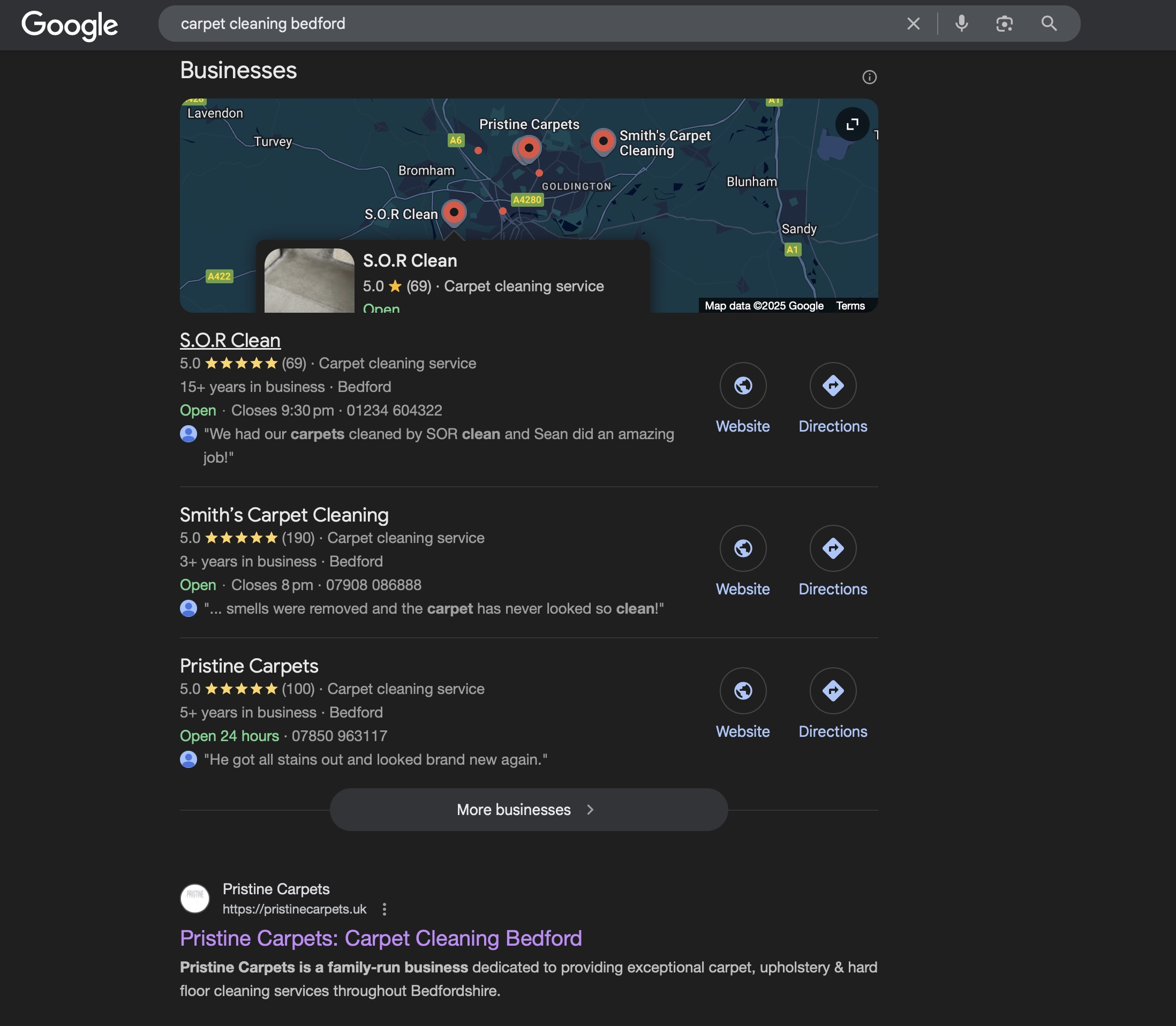
Pristine Carpets · Bedford
The screenshot demonstrates why we treat local search as a wider visibility problem rather than reducing the strategy to one position in one section of Google.
The website, individual services, local relevance, genuine work and customer reputation all contribute to the wider customer journey.
Build local relevance from the business outward.
The exact work depends on what is holding the business back. These are the main areas we investigate and improve.
Service-page structure
Important services need enough clarity and depth for customers and search engines to understand exactly what the business provides.
Selective location targeting
We identify locations with genuine commercial value rather than automatically generating a page for every town within driving distance.
Google Business Profile
Categories, services, photographs, business information, reviews and ongoing profile activity are considered where Maps visibility forms part of the opportunity.
Internal linking
Service, location, supporting content and proof pages are connected so the website has a logical hierarchy instead of isolated pages.
Local evidence
Genuine projects, customer reviews, photographs, credentials and case studies provide evidence that the business really operates in the market it is targeting.
Search foundations
Indexability, titles, canonicals, page structure, mobile usability, structured information and other technical issues are checked where they affect visibility or understanding.
You do not need a location page for every place you can drive to.
Location pages can be valuable. A town-page factory is not the same thing as a local search strategy.
The location deserves its own useful search destination.
- The area is commercially important to the business.
- Customers genuinely search for the service there.
- The business can realistically serve the area.
- The page can add something useful beyond changing the town name.
- It fits the wider service and website architecture.
Hundreds of near-identical local pages.
- Swapping one town name for another in the same copy.
- Targeting places with no meaningful business priority.
- Creating pages solely because a keyword tool produced a town.
- Letting multiple pages compete for essentially the same search.
- Assuming a website location page creates a Google Maps location.
For a deeper explanation, see Service Pages vs Location Pages for Trades and How Many Location Pages Does a Trade Business Need? .
Connected services. Different jobs.
Your Google Business Profile is important, but Local SEO is broader than profile management. The website can target services, priority areas and customer questions that cannot sensibly be contained within one business listing.
Local SEO
Local SEO considers the website, service architecture, geographic relevance, supporting content, internal linking, business evidence, Google presence and conversion journey together.
It is appropriate when the challenge is broader local search visibility rather than simply maintaining a Business Profile.
Explore our wider SEO service →Google Business Profile management
GBP management focuses specifically on the business listing: accurate information, categories, services, photographs, posts, reviews and ongoing profile management.
It can be appropriate as a standalone service where the website is already strong and the clearest weakness is the Google profile.
Explore GBP management →You can also read our detailed guide to Google Maps vs Organic Search for Trades .
Different businesses. Different local search problems.
Local SEO should reflect the actual market. These businesses operate in different specialist sectors and geographic environments, so the strategy cannot simply be copied from one to another.
 Bedford
Pristine Carpets
Service-led website development, local relevance, genuine work and customer reputation combined around a clearly defined local market.
Read the case study → South Wales
Oven Craft
A long-term local-search example supported by the website, geographic relevance and hundreds of genuine customer reviews.
Read the case study →Classic Leather Care
A specialist business positioned around genuine technical expertise, relevant regional searches and strong customer evidence rather than generic local-service copy.
Read the case study →Start with the market, not a predetermined list of towns.
Understand the local opportunity.
We review services, locations, competitors, current rankings, website structure and the Google Business Profile.
Decide which page should target what.
Services, locations and supporting content are mapped so the site has a clear hierarchy without unnecessary duplication.
Strengthen relevance and evidence.
Website content, internal links, Google information and genuine business evidence are improved where the opportunity justifies it.
Follow actual search behaviour.
Search Console, visibility and enquiries show which pages are gaining traction and where the next improvement should be made.
A focused campaign shouldn’t automatically carry a big-agency price.
Local SEO normally sits within our £197–£347 monthly SEO range. The appropriate level depends on competition, services, geographic coverage and how much website development is actually required.
For defined service areas and commercially useful local searches.
Setup from £197.
Where a broader or more competitive campaign genuinely requires additional work, monthly SEO can increase to £347.
What determines the scope?
- Number and value of important services.
- Size and competitiveness of the local market.
- Number of priority geographic areas.
- Condition and architecture of the existing website.
- Current Google Business Profile visibility.
- Amount of content, technical and internal-link work required.
Useful Local SEO guides without the agency jargon.
Local SEO for Trades
A detailed explanation of how local organic visibility works for trade and service businesses.
Read the guide →Service Pages vs Location Pages
Understand which searches deserve service pages, location pages or a combination of the two.
Read the guide →Google Maps vs Organic Search
See why Maps and website rankings should be understood as connected parts of local discovery rather than competing strategies.
Read the guide →Straight answers before you invest.
What is Local SEO?
Local SEO is the process of improving a business’s search visibility for queries where location matters. For a service business, that can involve the website, individual services, geographic relevance, Google Business Profile, reviews, supporting content and other genuine evidence that connects the business with the market it serves.
Is Local SEO the same as Google Maps optimisation?
No. Google Maps and the Google Business Profile can be important parts of Local SEO, but Local SEO is broader. Your website can rank organically for services, locations and customer questions as well as supporting the wider local search presence.
Do I need a location page for every town I cover?
No. We recommend selective location pages where the area has genuine commercial importance, customers search for the service there and the page can provide useful information. Producing near-identical pages for every town is not our approach.
Can a service-area business do Local SEO without an office in every town?
A business can build website relevance for areas it genuinely serves without pretending to have physical offices there. A website location page does not create a separate Google Maps location, and business-location information should accurately reflect the real business.
How much does Local SEO cost?
Our managed SEO starts from £197 per month, with broader or more competitive campaigns typically up to £347 per month. Setup starts from £197. The appropriate scope depends on competition, services, geographic coverage and the existing website.
How long does Local SEO take?
There is no fixed timescale. Existing visibility, website quality, competition, service area, reputation and the amount of work required all affect progress. We establish a baseline and measure changes rather than promising a particular ranking by a particular date.
Can you guarantee Google Maps or organic rankings?
No. Google controls its search results and they can vary by location, device and time. We can show documented previous results, identify opportunities, improve the relevant assets and track what happens, but no responsible Local SEO company can guarantee a particular position.
What if my Google Business Profile is the main problem?
If the website is already strong and the clearest weakness is the profile itself, our Google Business Profile Management service may be a more proportionate starting point.
Rankings and search-result examples shown on this page are recorded case-study snapshots. Search results vary by location, device and time. Previous results demonstrate relevant experience but do not guarantee the outcome of another campaign.
Which services and locations are actually worth targeting?
Send David your website, main service and the area you want more work from. We’ll look at the current search opportunity and tell you whether Local SEO, wider SEO, GBP management or website work appears to be the sensible starting point.
No obligation. No automatic recommendation for the most expensive option. No plan to generate fifty town pages before looking at the market.