
Carpet cleaning location pages: how to target more areas without creating thin content.
If you clean carpets across several towns, it makes sense to want visibility in more than one place. The answer, however, is not automatically creating dozens of near-identical pages with nothing but the town name changed.
Should every town you cover have its own page?
Usually, no.
But that does not mean location pages are inherently a bad idea either.
Carpet cleaning is a local service. Customers commonly search using a combination of the service they need and the place where they need it. That means geographical relevance can be commercially important.
The useful question is therefore not “How many towns can we make pages for?” It is:
Which locations represent meaningful search markets, and what is the best page structure for serving those customers?
This forms part of a wider SEO strategy for carpet cleaners, where services, locations, site architecture and genuine business evidence work together rather than being treated as isolated SEO tricks.
Why locations matter so much for carpet cleaners.
Someone who needs their carpets cleaned generally needs a business capable of reaching their property. Geography is therefore closely connected to the service itself.
What do they need?
Carpet cleaning, upholstery cleaning, commercial carpet cleaning and specialist rug cleaning can represent different search intentions.
Where do they need it?
Searches such as “carpet cleaning Bedford” explicitly combine the required service with the customer’s geographical requirement.
Who can actually do the job?
The website needs to make it clear that the business provides the relevant service and genuinely serves the customer’s area.
First decide which searches actually matter.
Before creating location pages, identify the services worth growing and the areas where those services are commercially viable.
A carpet cleaner may cover twenty towns but discover that only six or seven represent sensible priorities once travel time, competition, job value, existing customers and search demand are considered.
Our guide to carpet cleaning keywords explains how we group searches by service, location and customer intent before deciding which pages a website actually needs.
- What services are most valuable? Carpet, upholstery, commercial work or another specialist service?
- Where are the best customers? Not simply the largest towns, but areas you can serve profitably.
- Is there meaningful search intent? Does the location/service combination justify dedicated targeting?
- Do you already have visibility? Existing rankings can influence where further investment makes sense.
One generic “areas we cover” page usually isn’t the whole answer.
An areas-we-cover page can be useful for customers. It can explain the wider service territory and provide a logical route into more specific local information.
But a page containing little more than a list of twenty towns is not necessarily the strongest page to compete for every individual service-and-location search.
Someone searching for carpet cleaning in Bedford, for example, has a more specific need than somebody simply asking where the company operates.
Where the opportunity justifies it, a stronger local page can provide relevant information about the actual service available in that location and give the customer a much clearer route towards making an enquiry.
Think of the areas page as a hub.
It can summarise the geographical territory and link customers towards important locations.
It does not have to carry the entire SEO burden for every town the business serves.
What can a sensible carpet-cleaning structure look like?
There is no universal URL structure that every carpet cleaner must copy. But the relationship between services and locations should be understandable to both customers and search engines.
The examples above illustrate architecture rather than prescribing a single URL format for every carpet-cleaning website.
Service pages and location pages do different jobs.
A service page answers what you do.
A location page answers where you provide it and, where appropriate, how the service relates to customers in that area.
Problems begin when businesses create location pages that contain no meaningful local information, or service pages that are expected to rank for every town across an enormous territory.
We explore this distinction in more detail in our service pages vs location pages guide. The article is written for trades, but the architecture principle applies directly to local carpet-cleaning companies.
When does a location deserve its own page?
There isn’t a magic population size or search-volume threshold. Use several pieces of evidence together.
A dedicated page may make sense when…
- The business genuinely and regularly serves the area.
- The location represents worthwhile commercial demand.
- Travel time still allows profitable jobs.
- The target service matters commercially.
- Customers clearly search for the service in that location.
- You can create a genuinely useful page rather than cloned copy.
Think twice when…
- You have never worked in the area and rarely expect to.
- The town has only been selected because it is nearby on a map.
- The only planned change is replacing one town name with another.
- You are creating pages simply to increase the website’s page count.
- The location would generate work you do not particularly want.
- There is no sensible way to make the page useful to a customer.
Our broader guide on how many location pages a local service business needs goes deeper into the same prioritisation problem.
What should actually be on a carpet-cleaning location page?
Not filler about the history of the town. Not a paragraph generated by swapping one place name for another. Give prospective customers information that helps them understand the service.
The actual service
Explain what carpet-cleaning work is available, the types of properties or customers served and any genuinely relevant specialist services.
Clear service-area context
Make it clear that the business genuinely covers the location and how it fits within the wider operating area.
Real evidence
Where available, use genuine work, photographs, customer feedback or relevant case-study evidence rather than invented local claims.
Related services
Help customers reach upholstery, commercial or other appropriate services without forcing every subject onto the same page.
Useful answers
Address genuine questions about availability, process, drying considerations, quotations or the particular services offered by the company.
A clear next step
Make it straightforward to call, message or request a quote. Search visibility has little value if the page makes contacting the business difficult.
Why cloning town pages is a poor expansion strategy.
Imagine creating thirty pages where almost every sentence is identical:
“Looking for professional carpet cleaning in [TOWN]? We provide professional carpet cleaning throughout [TOWN] and surrounding areas…”
Repeating that formula across a large set of locations creates pages with very little individual value.
More URLs do not automatically mean more useful search visibility.
We’d rather prioritise the locations that matter, make those pages useful, connect them properly to relevant services and expand based on evidence.
This is also why our Local SEO approach focuses on meaningful local relevance rather than producing a town-page factory.
The objective isn’t more pages. It’s stronger visibility where the business wants work.
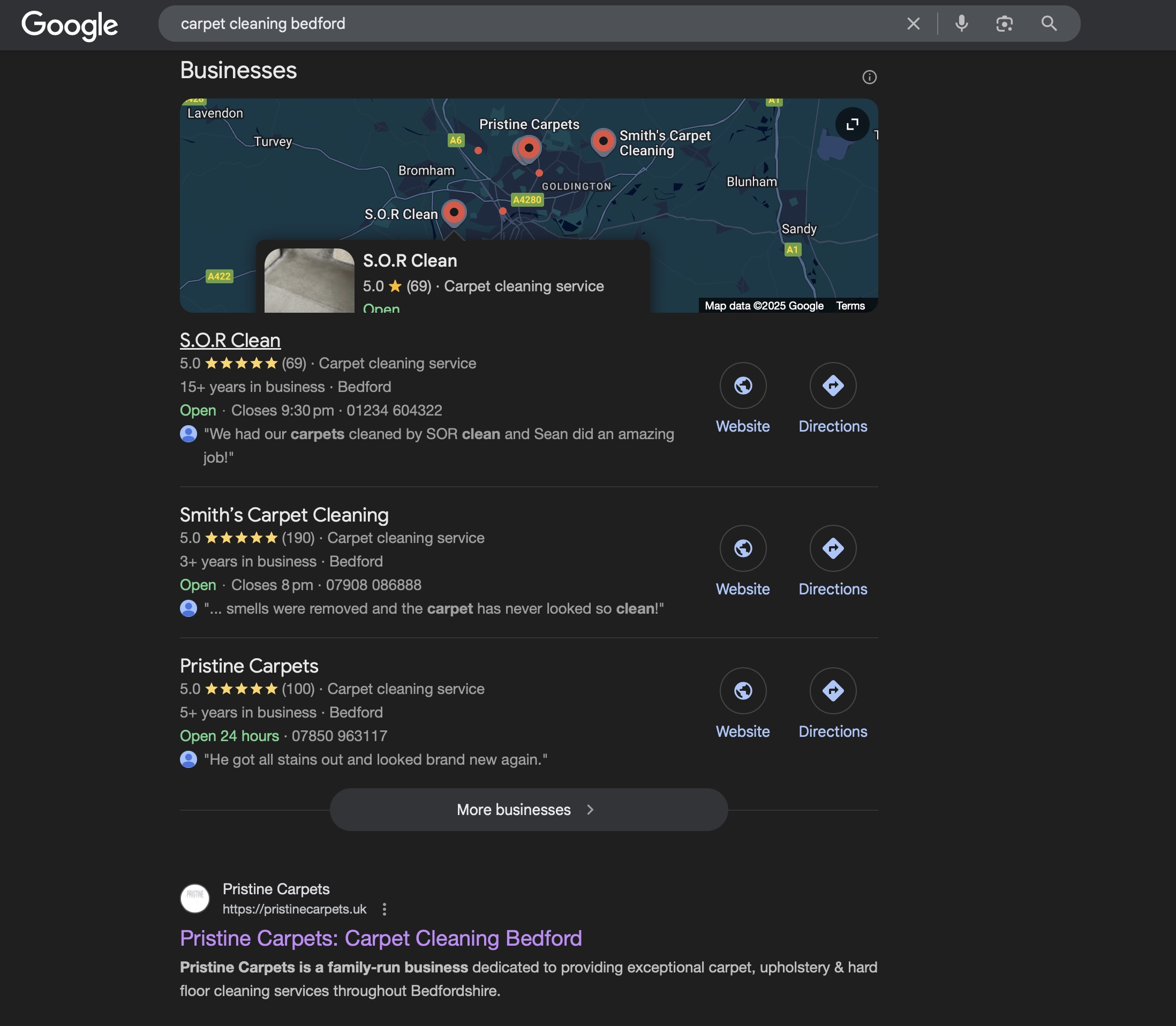
Pristine Carpets provides a useful real-world example of why the location/service relationship matters.
The recorded case-study snapshot includes #1 organic visibility for “Carpet Cleaning Bedford” alongside strong Google Maps visibility.
The important lesson is not that every carpet cleaner should copy one particular page structure. It is that the website needs to communicate the right service and geographical relevance clearly enough to compete in the market that matters to the business.
Read the Pristine Carpets case study or see how we approach SEO for carpet cleaning businesses.
Rankings shown are recorded case-study snapshots. Search results can vary by location, device and time, and rankings are not guaranteed.
Location pages don’t replace Google Maps.
Local customers can encounter a carpet-cleaning business through different parts of Google’s search results.
A strong location-focused website page can support organic visibility, while the Google Business Profile and wider local signals influence how the business appears across Google’s local surfaces.
That means the website and Google presence should support each other rather than being treated as competing alternatives.
See our guide to Google Maps vs organic search for a fuller explanation of the distinction.
Think beyond one ranking.
- Organic service/location visibility.
- Google Maps and local visibility.
- Useful business information.
- Customer reviews and reputation.
- Strong conversion from the website.
- Actual enquiries from the target area.
A better way to expand into more locations.
Start with priority areas.
Identify the towns and cities most closely connected to the business, strongest services and best commercial opportunities.
Build properly.
Create pages because they satisfy genuine customer and search needs—not because adding another URL is easy.
Measure what happens.
Watch impressions, rankings, enquiries and the actual quality of work generated from each target market.
Strengthen internal links.
Connect relevant service pages, location pages, useful supporting content and genuine evidence so the site forms a coherent structure.
Improve weak areas.
Don’t assume the answer to poor performance is always another page. Sometimes an existing page simply needs stronger relevance, evidence or authority.
Expand from evidence.
Once the first target locations are producing useful data, make the next expansion decision from evidence rather than guesswork.
Carpet cleaning location-page FAQs.
Should a carpet cleaner have a page for every town they cover?
No. Prioritise locations that represent genuine service areas and worthwhile commercial search opportunities. A business may cover many places without every one of them requiring a dedicated page.
Can location pages help a carpet cleaner rank in nearby towns?
Well-developed location content can help a website establish relevance to particular service-and-location searches, but creating a page does not guarantee rankings. Competition, website quality, authority, local signals and other factors still matter.
Can I use the same content and just change the town name?
That is not the approach we recommend. If a location deserves its own page, the page should provide useful information for customers in that target market rather than simply repeating generic copy with a different place name.
Do I need separate carpet cleaning and upholstery cleaning pages for every town?
Not automatically. The correct structure depends on search intent, the importance of each service, the locations being targeted and whether separate pages would genuinely improve the experience and relevance of the site.
Is an Areas We Cover page enough?
It can be a useful geographical hub, but it may not be the strongest answer to every competitive service-and-location search. Important target areas may justify more specific content where there is a clear customer and search reason for it.
How many location pages should I create at once?
There is no fixed number. We prefer prioritising the strongest opportunities, building them properly and expanding from the evidence rather than publishing a large batch of near-identical pages simply to increase page count.
Want to grow into more areas without turning your website into a town-page factory?
We build carpet-cleaning SEO around worthwhile services, realistic service areas and a website structure designed to turn relevant local searches into enquiries.