
Why your trades website isn’t generating enquiries.
Getting people onto a website is only half the job. If the right visitors arrive but don’t call, message or request a quote, something between the search and the enquiry is failing.
Here are the problems we look for when a trade or local service website gets traffic but doesn’t generate enough worthwhile leads.
A website can rank and still be bad at generating business.
Search visibility matters, but visits alone don’t pay the bills. A useful trades website has to connect three things: the customer’s search, enough evidence to make the business credible, and a simple route to taking the next step.
This distinction matters because a website with an enquiry problem is sometimes treated as if it simply needs more SEO.
That can be the wrong diagnosis.
Sending twice as many people to a weak service page can simply produce twice as many people leaving it. Equally, rebuilding a perfectly usable website won’t solve anything if it is attracting visitors searching for work the business doesn’t particularly want.
Before changing the website, separate a traffic problem from a conversion problem.
The useful question isn’t “How much traffic does my website get?” It is “How many of the right people arrive, understand why they should choose us and then make contact?”
Eight reasons a trades website doesn’t generate enough enquiries.
You’re attracting the wrong traffic
More visitors are not automatically better. A roofer looking for higher-value replacement work gains little from traffic dominated by people searching for DIY repair instructions. A specialist cleaner may value one commercial enquiry more than dozens of low-value consumer visits.
Look at which searches and landing pages actually produce calls, messages and worthwhile quote requests—not just which pages receive impressions.
Your service pages are too generic
“We offer a full range of professional services” tells a prospective customer very little.
Important services need enough detail to answer the questions behind the search: what you do, who it is for, how the work is approached, where you provide it and what evidence you have that you can do it properly.
Customers can’t see enough proof
Anybody can write “trusted”, “professional” and “high quality” on a website. Those words become much more convincing when they are backed by genuine customer reviews, completed projects, photographs, qualifications and evidence of experience.
For many trades, proof should appear on the service page itself—not be hidden on a separate gallery that the customer may never visit.
The customer isn’t sure you cover their area
Local customers frequently want reassurance that they have found somebody who actually works where they live or operate.
That doesn’t mean creating a cloned page for every town within driving distance. It means making genuine service coverage clear and developing dedicated local pages where the market and search intent justify them.
The next step isn’t obvious
Don’t make somebody search for the phone number after you have finally convinced them.
Calls, WhatsApp, quote forms or other relevant enquiry routes should appear at sensible decision points. On mobile in particular, the customer should be able to act without navigating several more pages.
You’re asking for too much, too soon
Long forms and unnecessary fields create friction. But an enquiry route can also be too vague.
Ask only for the information genuinely needed to progress the enquiry, then explain what happens next: a call, a message, a photo assessment, a site visit, a survey or a quotation.
The mobile experience is poor
Local-service searches often happen when the customer wants to solve something quickly. Tiny text, intrusive elements, slow-loading imagery, awkward forms and buried contact buttons make the decision harder than it needs to be.
Test the site as a customer would: on a phone, without already knowing where everything is.
You don’t know which enquiries came from the website
If calls, forms and messages aren’t measured properly, it becomes difficult to distinguish a website that is underperforming from one that is quietly generating valuable work.
The objective isn’t simply to count form submissions. Where possible, connect leads to the service, source and eventual value of the work.
Show the work instead of describing yourself as trustworthy.
Real photographs do more than make a trades website look better. They help demonstrate that the business actually performs the service being promoted.
The same applies to reviews and case studies. A customer considering a business can see evidence of the work, the type of customer served and the experience behind the claims being made.

Proof that belongs to the business.
Real job photography gives a prospective customer something a generic promise cannot. Pristine Carpets uses genuine work alongside its service content and customer-review evidence.
Show customers what the service actually looks like.
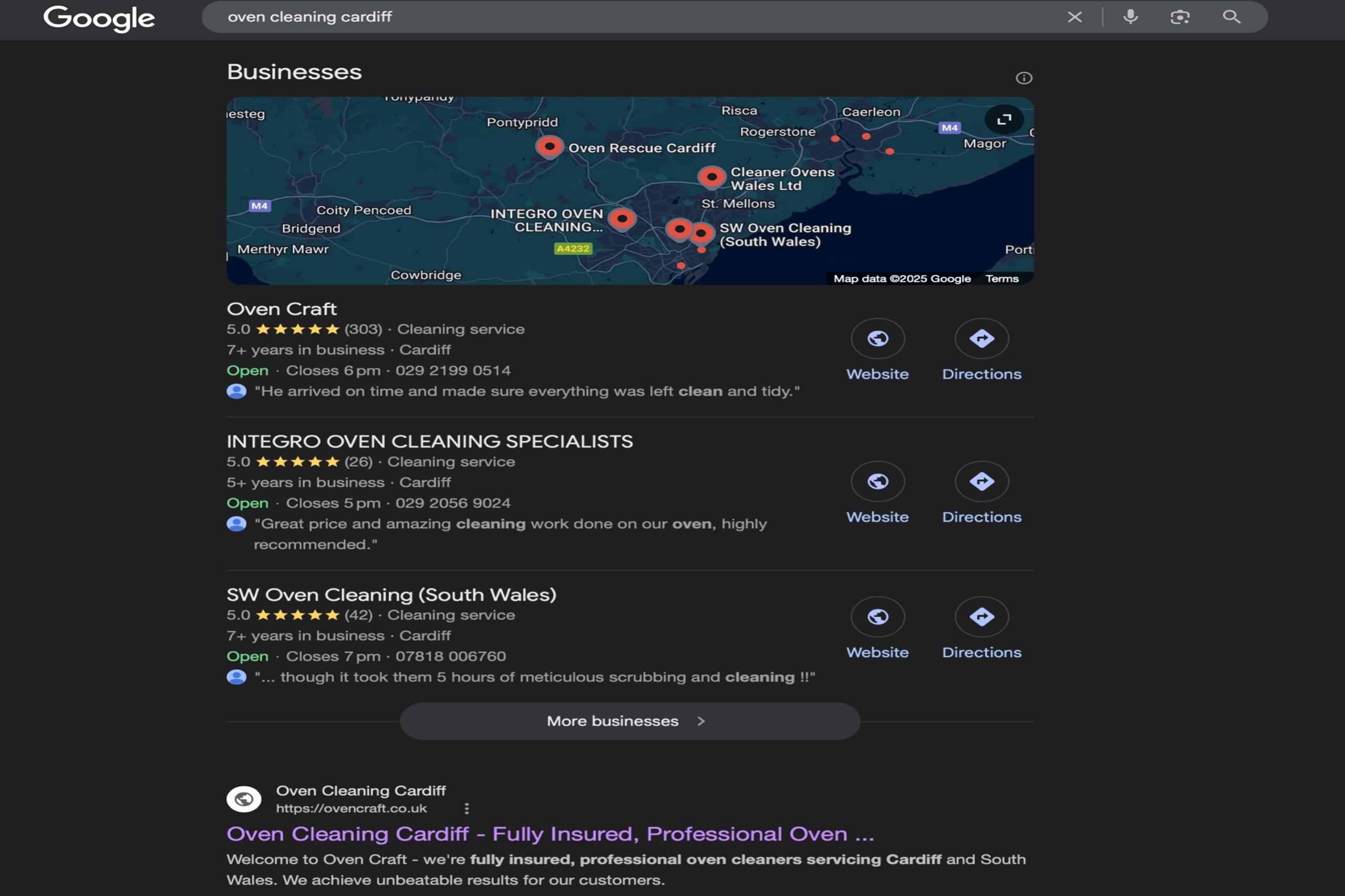
Oven Craft combines genuine work imagery with a straightforward local service proposition, visible review evidence and uncomplicated contact routes.
Answer the questions standing between the search and the enquiry.
Imagine somebody has searched for exactly the service you provide and landed directly on that service page.
They shouldn’t need to return to the homepage to work out whether you’re relevant.
- Is it immediately clear that you provide the service they searched for?
- Can they see the areas you genuinely serve?
- Is there enough detail to understand what the service involves?
- Can they see genuine photographs, reviews or completed work?
- Are important qualifications or specialist experience visible?
- Does the page address obvious concerns before the customer has to ask?
- Is the next step obvious?
Audit the website as a customer journey.
Instead of reviewing the website page by page in isolation, choose one commercially important service and follow the journey from Google to enquiry.
Start with the search
What would a genuine customer type when looking for this particular service in your market?
Check the landing page
Does the most relevant page actually appear for that search, or is Google being forced to use the homepage because the site lacks a suitable service page?
Look at the first screen
Can somebody quickly identify the service, business and relevant location without interpreting vague marketing language?
Look for proof
Before reaching the enquiry point, has the customer seen a meaningful reason to trust the business?
Test the action
Try calling, messaging or submitting the form from a phone. Look for unnecessary steps and unclear expectations.
Check what gets measured
Make sure you can distinguish a useful lead from traffic and understand which pages are contributing to genuine enquiries.
Sometimes the conversion problem starts with the website structure.
If the site has no useful service architecture, weak local relevance, very little proof and no logical internal linking, individual CTA changes are unlikely to solve the underlying problem.
That’s why website structure and conversion shouldn’t be treated as completely separate subjects.
Not sure whether the website has the right foundations?
Our complete trades website checklist covers service pages, location
structure, trust, mobile usability, internal linking and enquiry routes.
Does the website need more traffic, better conversion—or both?
Visibility problem
The right customers rarely reach the website. Search visibility, service targeting or local relevance may need strengthening.
Conversion problem
People arrive but don’t act. Review relevance, proof, usability, calls to action and the enquiry journey.
Targeting problem
The website may be visible but attracting searches, areas or jobs that don’t match the work the business actually wants.
Sales or qualification problem
The website may be doing its job. Pricing, response time, qualification or the follow-up process may be where work is being lost.
Usability problem
Check speed, layout, buttons, forms and how quickly somebody can understand the proposition on a small screen.
Measurement problem
Fix tracking before making major decisions based on assumptions about what the website is or isn’t producing.
Conversion and SEO aren’t competing strategies.
A well-built service page can improve the experience for a customer while also giving search engines a clearer understanding of what the business provides.
Useful service detail, genuine evidence, sensible internal links and clear location information are not tricks added for Google. They are often information customers want as well.
If the website already converts well but isn’t reaching enough of the right people, the next issue may be visibility rather than design.
What this looks like on real client websites.
These are operating businesses rather than demonstration projects. Their case studies show why website structure, proof and search visibility have to work together.
Pristine Carpets
Pristine Carpets reached a documented number-one position for carpet cleaning in Bedford following an SEO recovery built around a cleaner website structure, stronger local visibility and genuine customer proof.
Read the Pristine Carpets case study →Oven Craft
Oven Craft has maintained leading organic visibility in its market over the long term, supported by genuine job photography, a clear local proposition, customer reviews and direct enquiry routes.
Read the Oven Craft case study →Trades website enquiries FAQs.
Why is my website getting visitors but no enquiries?
First check whether the visitors are genuinely relevant. If they are, review the landing page, service information, proof, mobile experience and enquiry route. Traffic without enquiries does not automatically mean you need more traffic.
How can I get more enquiries from my trades website?
Focus on attracting the right searches, creating strong pages for commercially important services, showing genuine proof, making service coverage clear and reducing friction between the customer’s decision and contacting the business.
Should I put prices on my trades website?
It depends on the service and how reliably a price can be communicated before assessing the job. Where fixed pricing isn’t realistic, explaining what affects the price or how quotations work can still reduce uncertainty.
Do I need a new website to generate more leads?
Not necessarily. If the existing website has a sound technical foundation and can support better service pages, proof, internal linking and enquiry routes, improving it may be preferable to a complete rebuild.
Does SEO help a trades website generate enquiries?
SEO can increase visibility among people searching for the services and locations the business wants to target. The website still needs to convert that visibility into contact, which is why search strategy and website quality need to work together.
How should I measure website leads?
Measure relevant calls, forms and messages where possible, then look beyond raw lead volume to the type of service requested, location, lead quality and eventual value of the work.
Your website should help turn visibility into work.
If the current website is attracting the wrong enquiries, failing to explain your services or making it unnecessarily difficult for good prospects to contact you, we can look at what actually needs fixing.