
How Long Does SEO Take for a Trade Business?
Early movement, stronger rankings and a dependable flow of enquiries are different milestones. Here’s how to judge the time SEO needs—and whether the work is moving your business forward.
“Working” needs a clearer definition
A page appearing in Google is different from that page ranking prominently. A higher position is different from a customer calling. And a call is different from a profitable booked job.
For a trade business, the useful question is how long it may take to build visibility for the services and areas that can produce worthwhile work. That depends on the starting point, competition, website and amount of implementation.
Can Google find and index the important pages?
Are those pages appearing for relevant customer searches?
Are qualified enquiries becoming work worth doing?
Google’s SEO Starter Guide explains that changes can take anything from hours to several months to have an effect, and that some changes will not produce a noticeable improvement. That describes the response to individual changes; it is not a timetable for winning customers.
What could the first six months look like?
The stages below are a way to organise work and reviews. They are not measured averages, fixed deliverables or guaranteed ranking milestones. A recovery project may need a different sequence from a new website or an established business expanding into another town.
Diagnose and prioritise
Record existing visibility, identify commercially important services and locations, check access and measurement, and fix the most important barriers.
Ask: What is holding the website back, what has changed and why were those tasks chosen?
Look for relevant movement
Review whether changed pages are indexed, which searches they appear for and whether priority pages are developing useful visibility. Improve missing content, evidence and internal links.
Ask: Are the right services and pages moving, or is the report mainly showing unrelated traffic?
Connect visibility with enquiries
Assess qualified enquiries, quote outcomes and booked work alongside search performance. Allow for seasonality, tracking gaps and the time customers take to choose.
Ask: Does the evidence support continuing, changing the focus or reducing the scope?
Expand or correct the strategy
Strengthen services and areas showing commercial promise. Investigate weak results before adding more pages or extending the budget.
Ask: What has the campaign taught us, and what specific opportunity justifies the next investment?
Why two trade businesses can progress at different speeds
| Starting position | What affects the timescale? |
|---|---|
| Existing page close to useful visibility | There may be a focused opportunity to improve relevance, proof or the search snippet. Existing visibility gives us evidence to work with, but improvement is not automatic. |
| Established business with weak pages | Reputation and real projects may already exist, but turning them into strong service pages and a clear structure still takes implementation and reassessment. |
| New website or newly launched business | Important pages need to be discovered and assessed, while customer evidence and wider recognition may still be developing. |
| Several services across competitive towns | The work is broader. Prioritisation matters because a limited monthly budget cannot develop every service and location at once. |
| Technical problems or previous damaging work | Diagnosis and repair may need to happen before expansion. More content is unlikely to solve an unresolved indexing or structural problem. |
The scope matters as much as the calendar. A roofer targeting commercial roof replacement across several towns has a different task from an oven cleaner strengthening an existing local service page.
Google Maps and website rankings have different constraints
A business can improve its website’s organic visibility without appearing in the local map pack for every target town. Those results should be measured separately.
Google Maps
Google describes local ranking in terms of relevance, distance and prominence. Your position can change depending on where the customer searches.
Accurate profile information and genuine customer evidence matter, but adding a town page does not create a new physical business location.
Organic website results
A useful service or location page gives Google a relevant destination for a particular customer need. Its strength depends on the page and the wider website.
Separate the performance of individual pages and searches instead of expecting one generic homepage to represent every service everywhere.
Read our Google Maps vs organic search for trades guide for the distinction. Google also explains the factors behind local ranking in its own guidance.
What should improve before the diary fills?
- The work is implemented. You can see which pages, technical issues, contact routes or profile details were improved. A list of recommendations is not the same as completed work.
- Priority pages gain relevant exposure. Review impressions and search terms for the services and locations you want. Separate searches for your business name from searches by people discovering a supplier.
- Relevant visitors take useful actions. Track forms, telephone clicks and WhatsApp actions where possible. Check that enquiries concern the right services, areas and type of customer.
- Enquiries become worthwhile jobs. Record quotes, bookings and contribution after delivery costs. A larger volume of low-value enquiries can be less useful than a smaller number of good ones.
Compare meaningful periods, rather than reacting to a single day. For a low-volume specialist trade, one large booking can change the commercial result substantially. For a seasonal service, a quieter month does not automatically indicate a ranking problem.
Search Console’s average position also reflects a changing mix of searches and pages. Use it alongside priority queries, landing pages and enquiries; one site-wide average cannot tell the whole story.
A ranking snapshot cannot prove a timescale
The Pristine Carpets case study shows why repairing the foundations, strengthening service and location coverage, and making genuine evidence visible can matter. It does not establish a universal number of weeks for another business.
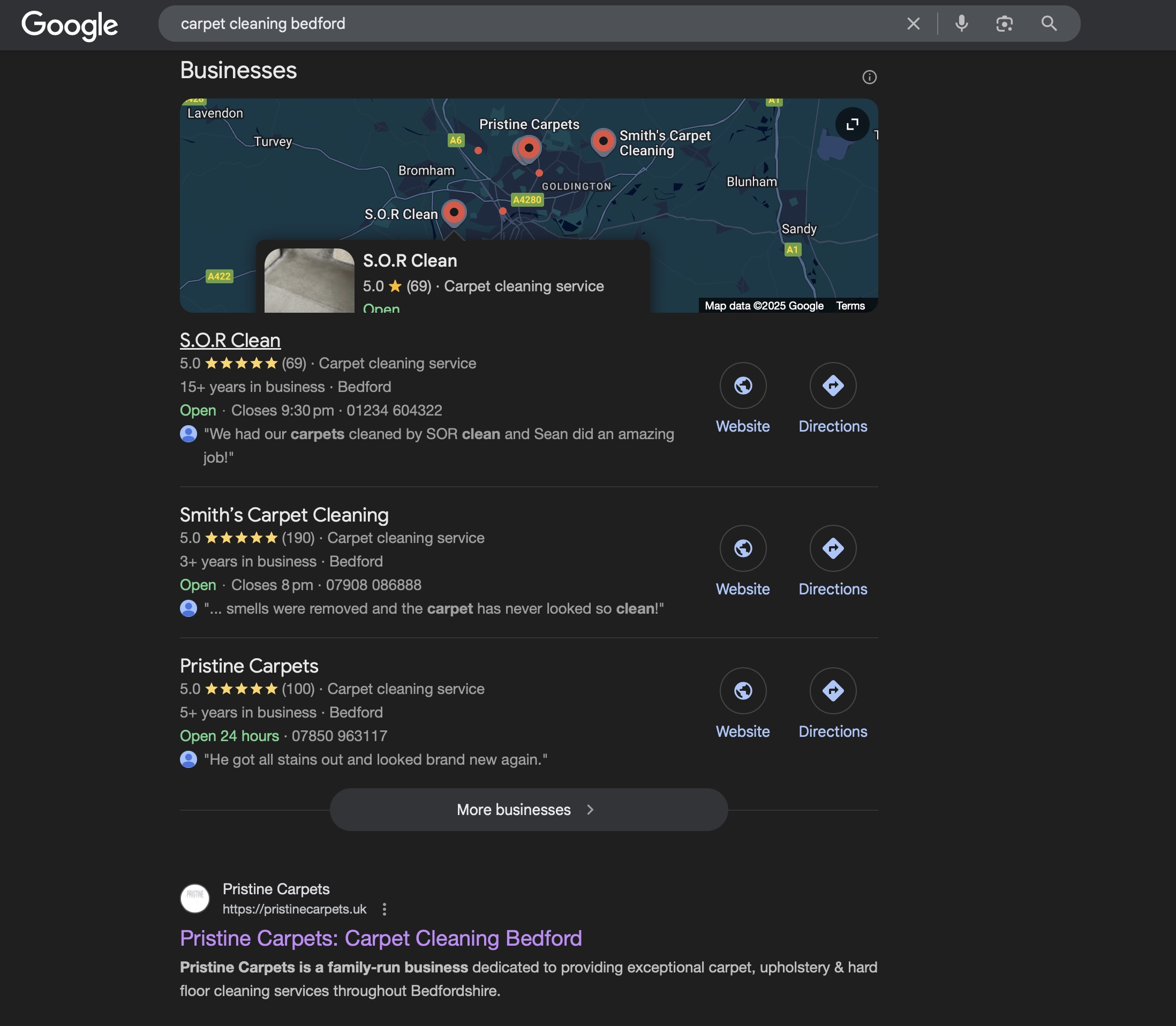
For any claimed rapid result, ask what the website was ranking for beforehand, when changes went live and whether the improvement produced qualified enquiries. A business-name search or a single low-demand phrase is a different achievement from sustained visibility for competitive customer searches.
Should you wait longer or change the approach?
Continue when the evidence supports it
Agreed work is being delivered, important pages are gaining relevant visibility, and there is a credible explanation of what still needs improving.
Where enquiries have started, assess their quality and booking potential alongside the cumulative cost.
Investigate when the explanation is vague
Little has been implemented, reports focus on irrelevant rankings, or the only answer is that SEO needs more time.
Check indexing, search demand, competition, tracking, page quality and the enquiry journey before spending more on the same approach.
What if you need work immediately?
Plan how the business will generate enquiries while organic visibility develops. Depending on the business, that may involve referrals, repeat-customer activity, partnerships or a carefully budgeted paid search campaign.
Our SEO vs Google Ads for trades article explains the different roles. Google Ads can provide paid visibility while a campaign runs; it does not buy better organic rankings.
Keep the budget realistic too. See how much SEO costs for trades for scope and break-even examples. A review window is a management decision, not a reason to accept an open-ended spend without evidence.
SEO timescales for trades: FAQs
Can SEO work in the first month?
Some changes may produce early movement, particularly where a specific problem is resolved or an existing page improves. That is different from promising a dependable flow of new work within a month.
Is three months enough to judge SEO?
It can be a useful review point for implementation, indexing and early relevant visibility. Whether it is enough to judge commercial return depends on the starting point, competition, search demand and customer buying cycle.
Should I expect results after six months?
By an agreed review point, you should expect a clear account of completed work, the evidence of progress and what remains unresolved. Six months does not guarantee rankings or profitability, and weak results should trigger a specific investigation.
Will publishing more blogs make SEO work faster?
Only if those articles address a useful customer need and support the wider strategy. More posts will not automatically fix weak service pages, technical barriers or an unrealistic target market.
Can I stop SEO once I rank well?
Completed pages can continue to attract searches, but rankings are not permanent. Competition, customer demand and the website can change. The appropriate ongoing work depends on performance and your growth plans.
Does Local Edge Digital require a six-month contract?
No. There is no fixed-term SEO contract; you can pause or stop. A suggested review period gives the work a fair assessment without creating a contractual minimum term.
What would a realistic SEO timescale look like for your business?
Send David your website, main services and priority areas. We’ll assess the starting point, likely workload and how progress should be reviewed.